
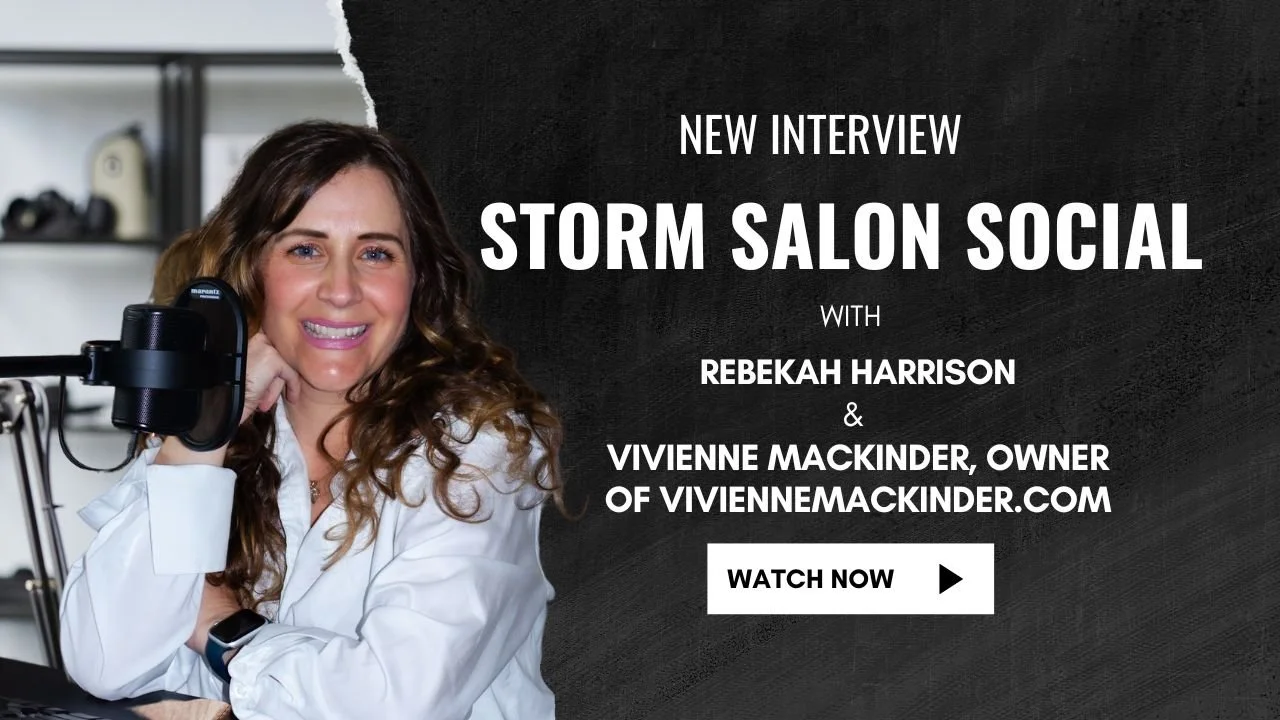
The hairdressers' hairdresser: a shy dancer who trained at Sassoon and went on to win NAHA seven times.
In this enriching interview, Rebekah Harrison of Storm Salon Social engages with the legendary Vivienne Mackinder, a seven-time NAHA Award winner, former Artistic Director for Vidal Sassoon and Trevor Sorbie, and pioneer of online education in the beauty industry. Vivienne, often referred to as "the hairdressers' hairdresser," shares her extraordinary journey and valuable insights from her illustrious career. Vivienne recounts her unexpected entry into the hairdressing world, transitioning from a shy dancer to a hairstylist inspired by the transformative power of hair and makeup seen in theatre. She trained at the London College of Fashion, initially focusing on hair for film, theatre, and television, but soon found her passion in three-dimensional hair artistry. Her career took a significant turn when she joined Vidal Sassoon, where she quickly rose to become the youngest Artistic Director. Vivienne discusses her experiences and challenges, including overcoming stage fright and the pressure of performing at high-profile shows. She emphasizes the importance of continuous learning, seeking mentorship, and understanding the historical context of hair trends. Vivienne's move to the United States was driven by personal reasons and a new start after the loss of her parents. She highlights her work with Trevor Sorbie and the development of his product line, which brought her to America. Her deep understanding of both British and American hair fashion provided her with a unique perspective. Throughout the interview, Vivienne offers valuable advice for aspiring hairstylists, emphasizing the importance of lifelong learning, finding great mentors, and staying relevant by understanding trends and client needs. She shares her least favorite experience, dealing with difficult clients during a high-stress bridal event, and contrasts it with the rewarding moments of successful transformations that truly connect with clients' desires. Vivienne discusses the evolution of hairdressing education and her innovative online training methods. She details her approach to virtual workshops, which offer personalized feedback and foster significant growth for participants. Her upcoming projects include a bridal workshop and the development of an app designed to support both consumers and hairdressers. In her personal reflections, Vivienne expresses a desire to write a book on staying true to oneself and overcoming life's challenges. She values compassion, continuous improvement, and the power of positive influence. Her favorite experiences include inspiring locations like Morocco and Venice, which fuel her creativity. Vivienne concludes by underscoring the significance of leadership in salon success, the need for community in the industry, and the importance of never settling for mediocrity. For those interested in her work, she invites them to visit her website, VivienneMackinder.com, and schedule a coaching call to create a personalized roadmap for success. This interview with Vivienne Mackinder is a treasure trove of wisdom and inspiration for anyone in the beauty industry, highlighting the dedication, creativity, and perseverance that define her remarkable career.
Full interview transcript
Vivienne Mackinder, educator and seven-time NAHA award winner, in conversation with Rebekah Harrison of Storm Salon Social. About 10,300 words.
Transcribed from the recording above and lightly edited for reading: filler words, false starts and repeats removed, nothing added. Where the recording is not clear, the transcript says [inaudible] or [name unclear] rather than guessing.
Standing out from the crowd
Vivienne: So let’s dive into the subject itself. How to stand out from the crowd, the secrets to an award-winning collection. This photograph here, I know many of us can go, “Oh, yes, I’m seeing loads of these images out there.” And the challenge is, when we see this in abundance, what do we do with it? Because all of a sudden, we are no longer standing out from the crowd. And Rebekah, I know that you see that. From your perspective, when you’re working with your clients, how do you navigate around it? There’s no point of difference. There’s no point of difference.
Rebekah: That’s true. You know, I always talk about how, when we see the back of the head in these shots, how does that relate to me as a customer? If I’m thinking about getting my hair done, I don’t see the back of my head. I see the front. So when I’m looking in the mirror, I want to see how it’s going to lay around my face. So when I do management for my clients, I tell them I don’t want any of those pictures. I want either side images or front images, because that just doesn’t connect when you see the back of the head. Sure, it’s beautiful, but it doesn’t connect with the client or the audience or the prospective client. It doesn’t say anything to us.
I don’t know where they learned to do that or what inspired them first, but you can look at a lot of social media, and whenever I get clients, I find that a lot of their social media is just covered with the back of the head. And that’s what we work on changing, changing that habit of taking pictures of the back of the head. Not that they can’t have any pictures of the back of the head, that’s fine. But I want to see the way it looks in the face, and the face framing. And I know with your education, you are big on face framing.
Vivienne: Yeah. And I think you made some really valid points. The back of the head, of course, is gorgeous. People want to see that. But how does it look from the side? How does it look from the front? Does it suit your eye and skin tone? And the point is that if you’re the same as everybody else, then you lose your magic. So be careful of copying. I would encourage you to be inspired and make it your own. So that’s my first photo tip that I’m going to give to you.
The next thing is practice on mannequin heads. So for example, when we look at these images here, a sweep back, the photo journaling of a glamorous wave closing in around the face, a little bit of elevation at the parting to give the lift and then making it have more volume. To me, when I’m working with a phone and a mannequin head, I’m still training my eye. And it’s no different to how I would see a look when I’m looking at the client in the mirror.
So now that I’ve given you that little tease and that curiosity, let’s dive into what Rebekah was speaking about. Let’s go into the big wide world, which is really a whole lot of fun. Winning awards is great for building your brand, because obviously that separates you. And if you want to be known as best in town, an award will always help, whether it’s a local award, whether it’s your ranking, whether it’s working with Rebekah and you get those kinds of recognitions through social. There are different ways to be recognized, to stand out from the crowd.
So Rebekah said to me, “Viv, can we look at some of your collections?” And Rebekah, I thought, well, this will be a cool thing to do, a bit of a teardown, and to tell you a little tiny bit of the backstory, because it’s not always what you think.
Rebekah: And there’s so much that goes into putting it all together. It takes a lot of time. You can’t throw it together overnight. It’s a lot of preparation and hard work that goes into it. And I love this first collection that you’re going to show us. I actually got to help you on that photo shoot. I got to produce it. So that was a lot of fun. But talk about what inspired you about creating this particular collection.
The samurai collection, The Journey
Vivienne: So I don’t know why, Rebekah, but somehow I was intrigued by a samurai warrior. I did a study and research, and I looked in fashion at some of the samurai images that have walked down the runway. And I thought, wow, how can I take that and turn it into a collection? So I started with the mannequin heads, and I started to line them all up in my studio to just look at, is it a story or is it a hodgepodge? And for those of you who want to enter an award, it has to have cohesiveness, and there should be a strong story. So it’s not about just taking a photograph, it’s the story that it evokes.
So it started off this way, and that crazy hairstyle that you’re seeing on the left actually turned into this. So Rebekah, what I actually did was I turned the wig upside down, and I was looking at it this way. And then I thought, well, what would happen if I flipped it the other way? So it had a really scary beginning, and then it went into the collection that I’m just going to browse through right now.
To me, a great photograph has originality, not only in how it’s photographed. To me, the elements of success in any photograph, number one is the model. If you don’t have a great model, then she’s not going to be able to show off the fashion, the clothes, and project her look. The next thing was amazing makeup. And what was quite interesting about this, Rebekah, was instead of going with the peach on the cheek, we went with yellow. And I thought, well, this is really interesting.
And the funny thing was, when I was talking to my makeup artist, I started to send him photographs, because I wanted an Asian model, and I found this beautiful Chinese girl. And I wanted just one girl to tell the entire story. So I have a Chinese model, but my inspiration is Japanese. But that’s okay. So I started sending him photographs of geisha girls, and I started sending him photographs with all these different makeup looks. [inaudible] “Vivian, that is so typical,” right? Like, there’s nothing original about that, the very clean face with a bright red lip and the kabuki look. And he said, “No, that’s not going to work.” So when he said, “Let’s do this,” it was like, oh my gosh.
So going on this journey, not only with the makeup being beautiful, the fashion. If you look at this, the fashion really enhances the look. Now, imagine the face if it was overmade up, I would lose the magic. Imagine if the outfit was embellished and too decorative, I would lose the magic. And the simplicity of the architectural lines is cohesive with the fashion. And then also imagine this if the model didn’t know how to move and create beautiful poses for the camera. Again, we wouldn’t have that magic. The photographer, [name unclear], an incredible photographer. And here you can see we’ve got just really strong, strong images that are just going crazy.
Rebekah: Wow. They’re beautiful. And I love how she looks different in every one. It almost looks like a completely different person, but you used one model. Talk about that a little bit. Obviously you’ve used people who are not professional models. Talk about the difference of using someone who is a professional model versus just someone who’s beautiful.
Casting the model
Vivienne: Well, the model is the star of the show. So therefore, you’ve got to have a model that the camera likes, because if you think about it, the camera is the client. It’s how the camera sees the face. So a chiseled face is beautiful. I’m always looking for amazing, amazing bone structure, because to me, that is the most important part of this whole aspect. Do I have a model that has an absolutely stunning effect? So that’s number one. She’s got to not only have a gorgeous face, she’s also got to be highly, highly photogenic. So I’m looking at face shape. I’m looking at the balance. I’m looking at the proportion. I’m looking at her expression.
So when I’m casting a model for a photoshoot, I’m going through her portfolio. If I see the same pose and the same expression, I think, well, what else has she got in there? And this model could talk to me through her eyes. She knew when to play it down. She knew when to play it big. So the model is selling your look.
Young ladies today are very camera conscious because they take so many selfies. So today you could put a notice in your staff room saying, “I’m doing a photoshoot, and I’m looking for some beautiful young girls between [inaudible].” You could describe the look that you’re looking for. And you’d be amazed. You’re looking for people who love to do selfies, because then they know, “Oh, this angle is good. This angle is good. This angle is good.” How do professional models know? Because they’ve been in front of a camera so many times, they know the angles that work for their face. So today, it’s easier than before. But it’s all about the photogenic aspect.
And also, there could be a face that’s very architectural. There could be a face that is more round and soft. So if I was doing a romantic story, I would be looking for very soft features, maybe a little more of a cupid face. If I’m doing something architectural, I’m looking for high cheekbones, tiny nose, very chiseled. And so I will always think about the character. A client sitting in your chair is a character. A client sitting in your chair has a status. A client sitting in your chair has her story. And a great photograph tells that story.
Rebekah: I love that. Viv, one of the things you reminded me of, when you were talking about if she makes the same facial expressions, then you probably don’t want to use her. It reminds me of when I was a kid. My mom used to get us involved in a lot of commercials and acting. We had our own headshots made. And I remember those headshots had all these different expressions on our faces, where we had to make so many funny but different expressions to show a variety. So it made me think of that. It was funny that you say that. When you’re able to see the different expressions or the different poses, all of that gives you, I guess, the awareness that you’re going to have someone who’s going to be flexible and not just the same the whole time. So I love that. And that’s why this model, she looks like a different person. And I think a lot of your collections have that, especially when you change the color of their hair, or the way that it’s shaped around their face, and they look like a totally different person.
Vivienne: Yes. And by doing that, obviously, here I’m working with wigs, I’m working with hairpieces. So for example, this hairstyle, I actually took out her own hair. I made a big hair pad on the inside, and I had a pixie wig, a human hair pixie wig. And I plonked the pixie wig on the top of her head to create that effect, which gave me that amazing sort of drama and that incredible shape. And also the movement, a photograph that has energy, that has movement.
Awards, teamwork and not quitting
Vivienne: So what’s interesting about this, this collection did win an award. It won the North American Hairstyling Awards for the Masters. And it was just a very, very magical moment. One of the things that’s interesting about this world is that, yeah, you can win awards. And this was an award that meant a lot to me. It was in London at the Royal Albert Hall, with my hair hero, Annie Humphreys. I think she’s one of the greatest colorists in the world. And the publisher of [name unclear] Magazine. And I won an award for my best collection.
And then here you’ll see other awards that I’ve won. The one in the upper left-hand corner was in Ireland. I won an international award, and it was actually a tree, a bog from a tree, and it weighed so much, it was unbelievable. And the award that [name unclear] is holding in this other shot, in the lower part of the photograph, was again so heavy, I gave it [inaudible] to hold.
But at the end of the day, it’s about a team. Teamwork makes the dream work. And that to me is the most important part of this, because you can’t do it without a team. And again, getting some recognition is nice in that moment. But what is more important than that small amount of recognition is who I became to win that award. And that you have to hold on to, because it pushed me, it stretched me, it challenged me. It was not easy. There were lots of things that were challenging on that [inaudible] shoot.
So at the end of the day, people see the result. And what very often they don’t realize is that there are struggles behind that. When people say, “Oh, I want to do what you’re doing, I want to be what you have achieved,” I will always say, “Well, do you want to do what I did in order to have this?” Because you may not want to make those sacrifices in order to get there. Or you may quit because it’s not working.
And in that second of not quitting, when I want to quit, and I want to give up, and I want to cry, and I want to do all of the above, I’m on the edge of the cliff and I’m on the edge of my emotions. And that tipping point is what makes the difference, to not quit, to go on. So many times when I’ve been doing collections, I’ve said to myself, “I know it’s not working right now. It’s okay, have faith. I know it’s not working right now, but keep doing what you need to do. Stay with your eyes focused on the goal and you will get there.” But I promise you, I have thrown mannequins across the room. I have had such moments of frustration. So it’s not always easy.
Rebekah: No, it’s not. And I love how you talk about it being about the journey. And that was actually the name of your collection, right? It’s called The Journey.
Vivienne: Yes.
Rebekah: The process, and going through that, and not just seeing the end result. And when you get to that tipping point, like you just talked about, I think that’s where we’re tested, with all of our emotions. Everything is tested. Can we do this? And when you face those challenges, pushing through to get to the other side and not quitting, a lot of times that’s where the breakthrough comes, right there at that place where it’s the worst. And sometimes we don’t respond well, and we end up saying “I’m sorry” later to the mannequin head we threw across the room, or to the person. But I think it’s that process of knowing there is a price involved in this, and you do have to put perseverance behind it. And I think you’ve really done that, Vivienne, with your collections. They have shown it with the fruit that comes behind them. They’re just so inspiring and so beautiful.
And that’s the thing I love about what you do, that you never compromise beauty. I think a lot of people have different opinions about beauty. Obviously it’s subjective. But I think that you always tend to put that life behind it. It’s almost like it’s classic. It’s timeless, what you do. And I think that’s so amazing. It doesn’t expire. It doesn’t have an expiration date.
Vivienne: No, it doesn’t. Well, I think great beauty withstands the passage of time, because it shifts beyond trend, and classic proportion is the scientific rule of balance and proportion. So I think that’s really important. And I do think that the collections that I create have a long shelf life, sometimes because they’re just an art piece. So art shouldn’t date. And so I think that’s really important.
Cool Kids, the collection inspired by chickens
Vivienne: The collection I’m going to show you next is actually one that was nominated and did not win. This collection is called Cool Kids, and it was editorial. So the brief here was to submit a collection that’s been in a fashion magazine, not a hair magazine, fashion, and a full-page story. And the collection going through, again, photographer [name unclear], makeup artist [name unclear], and the fashion here, extraordinary, the late [name unclear]. And just really, really cool.
So this here was about Japanese street trend. Again, isn’t it fascinating. I went back to Japan, because I was so fascinated by street trend. And I was also inspired by feathers. My husband at that time had chickens, a lot of them. And I was just blown away by the feathers and the colors and the textures. And I thought, how cool would it be to create a collection with feathers in the head?
So from here, I used, again, a wig. This is how the wig originally was, to the shoulders. I did a razor haircut. I had the fabulous Sue Pemberton color this. And this is how it turned out, with a lot of gel, hanging upside down in order to create this effect. [name unclear] created this interesting effect within the image, which is super powerful.
So here, working with two models in this particular case, again, you can see how we shifted the makeup to make it very minimal. So it’s all about the hair and the fashion. So again, playing with different colors and textures as we’re going through. The story was about color, feathers, Japanese trend. And this one, with the [inaudible] silver and gray, was actually inspired by one of my husband’s chickens, which was pretty cool. It’s called a Sebright chicken.
And so when I sent this to Sue Pemberton, I sent her photographs of chickens. And she said, “What are you thinking?” I went, what, do you want to do chicken hair? No, no, no, no, I want it to be Japanese street trend. And I want to be able to take da da da da da. And I want it to be feathers. And she’s like, “You’re kidding me, right?” So I sent her all these images of the birds, and I said, “No, we’re going to do that.”
And what was really interesting about this was that the moment the hair was distorted, the pattern became distorted. So you can see that I did it with the cool tones, but I also did it with the red. [inaudible] going through there. And this was a rainbow finger [inaudible] wave that I did on the long hair. But if you look at the fashion, everything works, and the elements work so well. I wanted it to have a real fashion story. I wanted the movement. I wanted the drama. And as you can see, this model knows how to move her body. So that’s what made that super exciting.
So that collection, I sat in the audience and I was like, “I think this is going to be a really strong collection,” because it really was.
Rebekah: It’s gorgeous.
Vivienne: And it didn’t win.
Rebekah: Yeah, and I know that was hard. But it did get published, right? In a magazine. Was it an international magazine?
Vivienne: It was published in a Swedish magazine. I believe it was Swedish, it was overseas. And then it got published in many, many magazines [inaudible].
Rebekah: And the thing about that collection, you were able to use it a lot, not just in publications, but you used it a lot in graphics that you would make, or in promoting your education. So it had a long lifespan, right? It was very versatile, and it was used for a long time. And I love it. It’s so beautiful. And to think that you were inspired by your chickens. It’s timeless, too. How many years ago, what year was it that you did that? Because it was before I came to work with you. It was actually years before that, I think.
Vivienne: I don’t know. I don’t even know. I don’t know the date of it.
Rebekah: But what’s so amazing about it, like we just talked about, is how your collections are often just timeless. It’s something that you would see today. It doesn’t feel outdated in any way. It doesn’t feel like you were just chasing a trend. That’s one thing that I love about what you do. It’s not about a trend. It’s about setting those trends and really raising that bar, and not being weird. Because collections I’ve seen can just be not beautiful. They lose that when they try to be weird. But you’ve always kept it beautiful. And I love that.
Uncompromised Beauty, and why a loss can still pay off
Vivienne: Yeah. So here, Rebekah, what I wanted to do was just do the total opposite. Very often, if I’ve done something very bright and colorful, then I want to go to the opposite extreme. So this collection was submitted again to the North American Hairstyling Awards. It got nominated. It was in the final. And I just thought, let’s just do real hair, and let’s just do something very beautiful. And it was called Uncompromised Beauty. So with this one here, it was like, okay, let’s just keep it real.
So I love the collection, and this is the irony of it. It did not win, which is okay. But the organization, the Professional Beauty Association, who hosts the North American Hairstyling Awards, used that collection for a huge campaign. They came back to me and said, “We want to use this.” Out of all the thousands of entries, that was the one that was picked. And that was seen more than any winning collection. So sometimes you’re at the mercy of what the judge likes, clearly.
And I would always say, don’t compromise beauty for a trend or a gimmick, because no one comes into the salon saying, “Could you make me look ugly?” And there really is a fine line between creativity and bad taste. Creativity is the ability to take things that exist, that don’t exist together, and combine them and do something new. That’s a real creative process, the creative process of problem solving. So every day our clients sit in our chair, we problem solve. The hair is limp, or the hair is dragging down the face, or the hairstyle ages the client by 10 years, or the color is drab and has faded out. They’re all problems which we are meant to solve, right?
So the genius about when you photograph your work is that your images can work for you when you’re asleep. And that’s the reason that every single one of you listening to me should start to take it very seriously, how you journal your work, how you photograph, and what you put out there, because it’s your brand. It says, “This is who I am.” And instead of chasing the client, I challenge you to be the magnet, to bring the client to you by promoting beautiful work that’s true to you, your style, and let that be a beacon to attract rather than you chase. And then from there, have the ability to say, right, when I did that, now let’s look at something totally different.
Rebekah: Before we move on to the next one, I was going to say, that collection was gorgeous. And even though it didn’t win, we were able to use those photos for a lot of marketing pieces. And they actually got some attention. I remember the booklet that I got to make for you from this collection, and it got some attention from different brands that decided, “Wow, I want to work with Vivienne again.” So that was really cool. We were able to use it. So yes, you can submit to different awards and may not win, but you can leverage those pieces for your own brand, to build that. And I think Vivienne has done that a lot with her collections. Just because a collection didn’t win doesn’t mean it’s not gorgeous, and it’s not amazing, and it won’t draw people to your brand. So I love that it was used beyond submitting to an award. It wasn’t wasted.
Vivienne: No. And you know what, too, if you do a collection. So for example, we are hosting again this year a photographic workshop. And I’m going to be working with Joseph Cartwright, who’s not only a brilliant photographer, he’s a great coach. He’s a great trainer. He’s a professor, actually, also at Parsons University in New York, and in the creatives. So very creative, very able to communicate, which is wonderful.
And so what we do in that is we tear down what it takes to create a beautiful photograph. How to cast it, how to budget, how to create the concept, how to explore your own creativity versus copying something on Pinterest. We’ve now almost become subconsciously trained to just copy and mimic a photo reference, which sometimes works. But more often than not, it doesn’t. It becomes an interpretation of it.
And the higher you sit on the pedestal, because maybe your clients love you so much, they think that you can do anything. Right? So you’re sitting on your success pedestal, that everybody else put you on. You didn’t even ask to be put on that pedestal. And now they’re coming in with these photographs thinking that you’re a magician, and that you can do it. And you’re looking at it, “I can’t recreate that. That’s not possible. I can be inspired. I can interpret it.” But from the idea to the interpretation, sometimes there’s a huge gap in between.
So what we try to train you in is to dig into your own wealth of your own creativity, and we take you on this amazing journey. So to me, journaling your work, and we’re going to get into a little bit towards the end, just some tactics that you can use right today, is about developing your brand. And that’s what’s important.
Finding inspiration instead of copying
Rebekah: Viv, tell me. If someone has been used to copying other people’s work, and they get inspired and they just recreate it, it does look like they just copied it. It doesn’t look original. I love how you have been inspired by your chickens to create these amazing, beautiful images that don’t look like someone else’s images. They resembled the hair of the chicken, but you were inspired by nature, by the creation, which I love. So tell me, how would you recommend that someone shifts into that? How do they get to that place of not just consuming and copying what other people are doing, but really getting inspired in other ways like you did?
Vivienne: Well, first of all, it’s a great question, Rebekah. I think the first thing that comes up is trust. I think of us as having three brains: our head, our heart and our gut. And I think that when you’re inspired, it very often comes from that gut sense of “wow,” something stirs, that then warms the heart, and then the head says, “Oh, we’re going to do it,” right? So I think all those senses need to be very awakened.
I think we need to slow down, because you can’t get inspired when life is doing this, fast, fast, fast, fast, fast. All I know is there’s something flapping in front of my face. I have no idea whether it’s one finger, two fingers, because it’s just flapping. We need to stop. We need to look. We need to dwell. We need to ask questions. We need to be curious. What would happen if I tipped it upside down?
Like a child, like the curiosity of thinking, “Well, that’s interesting. There’s a plug socket. Why don’t I just go and see if I can jam my toothbrush in that plug socket? Why not?” Right? And it’s like, “Oh no, what have you just done?” Well, it’s being creative, because no one’s ever done that before, right? And so children are the kings and queens of creativity and using the imagination. They can take a box and imagine it to be a house. And when you say, “No, you can’t play with that box,” it’s like, “No, no, no, that’s my house, Mummy.” So we need to get back to that essence.
So first of all, you have to slow down. Secondly, you have to be able to look at things and dwell and be curious and ask “what if.” You can be inspired by a word. The collection I’m going to show you next is called Kaleidoscope. So that word, when I say kaleidoscope, what do you think of? Do you think of one color, multiple colors? Do you think of movement? What do you think of when you think kaleidoscope? If I say the words “shadow” and “shapes,” that takes you somewhere else. Music, I’ve very often been inspired by music. What would that type of music evoke as a visual? So you can be listening to beautiful sounds, right?
So when you start to awaken the senses and listen to yourself, and trust, then you’ve got to do something. You can’t wait for all the stars to be in alignment before jumping. You have to have faith and say, “I’m just jumping, I’m going to go for it.” And off you jolly well go. And the greatest things in life are a team effort. You may go faster alone, but you’ll never go further alone. So the team of like-minded people around you who are excellent, that is so important to capture.
And if you’re trying to create a gorgeous image, you need a great photographer. Not a good photographer, a great photographer who understands your sensibility. And within any market around the world, there is a photographer. Maybe there’s a photographer doing bridal, and he understands location work, and he understands working in very difficult lighting because he’s photographing brides. Or she’s photographing brides. They understand how to take an average person and make them look more gorgeous. It’s not a model. Now that sort of photographer, who may be in your neighborhood, would love to do a fashion shoot, would love to do a hair story, because after a while they do get tired of working with brides. Right? So they’re out there.
And you know, the best place to post your interest in things is in the bathroom in your salon. [inaudible] “I’m looking for…” Everyone has to go to that bathroom at some point. And everyone knows somebody who knows somebody who knows somebody. Oh my gosh, the law of connection. There may be so many network connections right in your chair, or going to the salon bathroom. And if you let them know what you’re looking for, you can barter services.
Rebekah: Yeah, absolutely. Well, I love what you talked about, how it’s about childlike faith when you are wanting to be creative, to create something new and not just copy. Have that childlike sense, to ask questions and to go past limitations, because kids are like that. They will ask a lot of questions, and they’re not afraid to. And so I think that’s amazing.
Kaleidoscope, and posting the work you want to do
Vivienne: So are you wondering what the heck this is, Rebekah?
Rebekah: I know. What is this, Viv?
Vivienne: Well, I found it in a cupboard. And it was once upon a time something pretty special. I just found it in my hair vault, and it was like, this is ready to fly into the sky. But I stripped everything off of it. And this is blocking net, which is used for making hats, and it has starch, so you can mold it into any shape. So this is how it ended.
Rebekah: Wow.
Vivienne: And it’s quite interesting, because then I was at NAHA, and I got to see it. It was there on a big screen. And so it was like, “Oh, how cool is that?” So when you think about the ridiculousness of looking for possibilities, and thinking, how can I possibly go from this, it looks like roadkill, to this, right? To this.
And then obviously with this collection, it was called Kaleidoscope. And so everything in here, you’ll see what makes this special is that the lighting is beautiful. The fashion is super simple. The makeup is very quiet and very simple. And it’s a question of less is more, in order to create the magic and the pop. And again, here I wanted to create a hair hat. I used a little wig underneath, like a pixie wig underneath, and I made this hair hat, which also has a pixie wig on the top. And then I just created the layers, and then I colored it. And this one here was a team of amazing colorists. We must have worked on coloring this one for days, and then building it was a real challenge. So as I said, you’ve got to keep your eye on the prize. What is that prize, and what do you want to win?
And we’ve come full circle. This is gorgeous, but when you see it so much, it becomes boring. This is practicing on a mannequin head, and trying interesting things, and experimenting, and photographing with my phone with a mannequin.
And I just wanted to mention here, Rebekah, I was coaching somebody who’s in one of my training programs, and I was looking at her feed on social. I was like, well, it’s all the same thing, just as we were speaking about before. And I said to her, “When I’m looking at your social feed, how come,” and this is the haircut that she had actually done for me in class, “how come this is not on your feed, showing your clients that you can do beautiful haircuts? Because this color technique,” here’s her feed, “this color technique and these hairstyles are a dime a dozen. But you just did the most beautiful haircut that not many hairdressers can do. How come you’re not posting it?”
And what was interesting about this, Rebekah, was she looked at me like, “Oh.” I said, “Well, if people don’t know you can do it, how will they know?” If you are going to be attracting, and you’re going to project to the world, you’ve just fallen into a trap of same old, same old, which diminishes the value of your services. And I’m sure you see it all the time.
Rebekah: Yeah. And one of the things that I talk about is we have to understand what your goals are. Maybe you’re doing haircuts a lot right now, but you want to do more extensions. So you have to showcase that. You have to put that out there and educate your audience on what it means to get extensions. What kind of extensions are available? What is it going to do to my hair? All these things that they need to know about, to make them curious to want to get them. What are the benefits? So I think that’s really important. When we’re putting out the same kind of content, we’re going to attract the same kind of clients. So if you’re like, “I’m tired of doing balayage, I just keep getting the same ones,” it’s like, but that’s all you’re posting, and that’s why they’re coming to you. So you have to start putting things out there that you want to start doing. So if you want to start doing more bobs and more short haircuts and cute cuts like the ones you just showed us, then put those out there.
Where hair trends are heading
Vivienne: Yeah. And you know what people tend to forget in our industry? We’re part of the fashion world, as an accessory, a vital accessory to the world of fashion. And fashion does not stand still. It has four seasons. And we tend to act as though it’s always going to be around. Twenty years ago, pre-balayage and ombre, we did finger painting, and we did something called flying colors, always in short hair, so that the colors would pop.
When balayage and ombre came in, and it was obviously the very large and rooted hairstyles with the color just tipping on the ends, I remember so many of us thinking, who’d be crazy enough to paint the ends and give a client a regrowth? She doesn’t need to come in forever, because you only colored the ends, right? And that color could last for a year, because there’s no regrowth. Now, obviously, since then we’ve been more creative with some babylights, we’ve been more creative with a different shadow at the roots, so there can be a bit of a grow-out. But we trained our clients to have a very long lifespan with their color. Obviously color oxidizes, it fades, et cetera, et cetera. Obviously it’s eventually cut off. But we went from coming in every three weeks for your root touch-up to “you don’t need to.”
So everyone thought, “That will never work. We’ll lose money.” What did happen? It worked. What did happen? Everyone jumped on the painting bus. And we have done very well and been very successful with it. But the bus is about to leave. And if you are not ready for the next trend… They always say there’s danger in sitting at the table of success too long. And when you keep doing the same thing, you will get bored. And it shows up in different ways. It’ll start to feel like I’m on a bit of a hamster wheel, and you don’t put your heart into it. Because some people thrive in repetition. But there’s a point where no one thrives in repetition, because it just becomes dull. And habits are repetitive without conscious thought. Creativity is in the conscious thought with no habit. Big, big difference, right?
Rebekah: Yeah, it is. What would you say is coming now in trends for hair? What do you see happening with the trends?
Vivienne: Well, I think there are two things that have to happen. One is a return of glamour, and not undone, because everything has been undone and relaxed and lazy. It’s almost like the COVID look. And it was happening long, long before that, because originally grunge happened back in the 80s. And then it kind of slipped away, and it came back in, and it slipped away and came back in. Just like punk was a 1970s thing, and the edginess and the rawness and the spikiness and the [inaudible] and all the different punk-related things, the primary colors.
We’ve now left the primary color world, as beautiful as it is. And I love it on the right person. That ship is passing too, which for some will be really sad, because they were just so genius, and they had an explosion on social media by being the vibrant artists of primary colors. And I love it on the right person. But from a fashion perspective, it’s sailed, it’s gone.
So I think the next thing that’s going to happen is wash and wear, that is easy for that client, a little bit more polished, shiny, and done up. And a goodbye to long hair. Long hair will always be beautiful for some women, absolutely, absolutely. But too many women are wearing long hair that really shouldn’t be. It’s not their most flattering look, or their hair is not gorgeous enough or abundant enough to hang long. So I think we’re going to see a return of short haircuts. I think we’re going to see a return of perms, wash and wear, cute little perms. And I think color is going to go more and more natural, and be less about dimension, more like just a lovely shine, and glassy highlights and lowlights strategically placed. I think that could also be really lovely. But I think that’s where we’re going to go.
And what I wanted to also say is that the art of cutting hair, a lot of people don’t know how to cut hair short. Our industry is actually in a crisis. They don’t know how to cut hair short. And secondly, they don’t know how to dress and style hair. And I just want to show you one final reference, to think about how you could right now start to expand your repertoire.
So for example, this is a color that I did. She’s just a little bit lighter on the ends, and she’s got a little bit more of a rooted area, but it’s very soft. And a little bit of a tease at the crown, some facial frame. She was set. And I changed the background to just give her that sense of, I’m either on the beach or I’m in the woods or wherever. I just played around with backgrounds. And then here, from her being down to her going up. And again, you can just see it’s just the mannequin, and just looking at how I could really create a lovely, lovely look.
So what I know is that today you can start with your mannequin and a phone. Today you can start training your eye to see how the camera reads what you’re doing. And then if you feel, “Right, I want to now go to the next level,” that’s when you start to work with professional photographers and professional models, and your work gets elevated and elevated. And that’s where the magic happens.
But for what you do, Rebekah, the branding, like what is your signature look, what is the brand, and a strategy that is seasonal and planned, is so genius, because you are doing the right look at the right time. So many times people are either too ahead of the curve or behind the curve. Like, you wouldn’t be selling bikinis in the thick of winter, and you wouldn’t be selling beach, wash and wear hairstyles in the middle of winter. But when people are in the summer energy, and they want relaxed, easy and so on and so forth, that’s when you sell those things. And sometimes hairdressers get caught in their habit, and they don’t realize this is not the season for it anymore. Or the fashion bus just left and you’re left behind.
Rebekah: It’s good. Yeah, seasons come and go, and so do trends, right? They come and go. Some of the trends I’ve seen a lot are the mullets and things like that, that I don’t like, to be honest. But we’ve seen a lot of those. You’ve done a lot of shags in the past that are really beautiful, and you have some education to teach people how to do the right kind of shag haircuts.
And I love how you talk about short haircuts coming back, because I think that’s amazing. They’re just gorgeous. And a lot of your education, and a lot of even your background, was in classical, timeless cuts, from when you were trained at Vidal Sassoon and when you worked there. And your education is great, because you have a lot of education to teach people how to cut hair if they don’t know how. Like you said, if they’re always just doing trims on long hair, kind of like mine, then they may not know how to cut hair. So that’s great for them to go get some education from you, whether they do it online or do it in your virtual coaching, where they would be able to see you and you see them, just like we’re doing right now, and get feedback and grow in that area.
So you don’t have to be ignorant if you don’t know how to cut hair. Maybe you didn’t learn it in beauty school, but you still can. It’s not too late, and your team can. So if you’re a salon owner watching this right now, and you’re like, “I need to get my team equipped to cut hair, and they don’t know how,” and to get ready for that trend of shorter hair, then you should check out Vivienne Mackinder’s education and get involved in what she’s doing.
And if you watched this and you’re inspired by wanting to do editorial work, wanting to do photoshoots, wanting to submit to different awards, then we would recommend that you take the editorial class with Vivienne. She’s got online education if you’re not able to come out to do an actual photoshoot workshop. But if you are, I think she has one coming up really soon, and there are actually a few spots still left. So I encourage you to take advantage of that opportunity and learn from the best.
Fear and confidence
Vivienne: Oh, thank you. Thank you so much. And what I would like to emphasize is that very often fear gets in the way and stops us from doing things. When you feel jammed up, and you say to yourself, “I don’t know how to do that,” the only way to get the confidence is to learn the skill, the technique. All techniques are teachable. And when you learn the technique, you’re learning a system. And when you learn it well, and practice it, and practice it, and practice it, the confidence will increase.
So fear is a great teacher. When fear comes up for me, the first question I ask is, “Well, why am I afraid?” And then the next question is, “Well, what do I need to learn?” And then the next question is, “Why do I want to do it?” And I must know my why, because my why will motivate me to get up and do it. And then the question to myself would be, “Well, if I don’t do it, what will happen?”
Rebekah: Right.
Vivienne: Will I have regret?
Rebekah: Yeah, will I have regret? Will I look back and feel that sense of, “Man, I should have taken advantage of that opportunity”? And like you said about fear, I think that’s so important. If we find that we’re hitting a wall, and we just find ourselves nervous about doing a certain look. I’m not a hairstylist, but I know people are afraid of that. And I think you don’t run from it. I do get afraid of other things. And I know it has helped when you just face those fears and embrace it and go, “What do I need to learn? What am I missing that causes this fear to make me frozen?”
Consultations: try-on apps, face shape and lifestyle
Vivienne: But you know what, Rebekah, what’s really interesting about right now, just to sort of conclude what we’re saying, is that there are more and more apps coming out where you can try on your own hair color and try on the hairstyle, and the consumers are all over it. And when a consumer has tried on her hairstyle with an app, it may look cute, it may not, or she’s bringing in a photo reference. They are looking. And why are they looking? Because the hairdresser is not giving them the advice, and isn’t able to visualize.
For example, looking at your beautiful face and your beautiful hair right now, how many of you could visualize you with a pixie, could visualize you with a bob, could visualize you with a lob, could visualize you with a shag? How many people could visualize and know the points on your face where that shape should be to flatter your face shape? And then it’s going to change your personality. Because if you’re having something that’s more shaggy, it’s a little bit more rock and roll. If you’re having something that’s a lob, it may be a little bit more classic and more traditional.
So as you’re looking at all of those things, if the hairdresser doesn’t have the eye for it, what’s going to happen? The consumer is out there looking, apps, et cetera. Now they come in armed and dangerous. And I have heard this several times now. They bring in an image and the hairdresser doesn’t know how to do it. And then they ask the owner of the salon, “Is there anyone here who can do it?” And everyone runs terrified. That is a crisis for our industry.
Rebekah: Yeah. Well, I love that we talk about someone giving that recommendation, and I think that’s important. I haven’t had a hairdresser do that for me, where you can say, “Okay, Rebekah, you have this type of face shape. This is what would be best.” And I do tend to have the same hairstyle for years and years. And yes, we bring pictures in because we don’t know what else to do. But a lot of times when they bring those pictures into the salon, it’s not just about the hairstylist not knowing what to do or how to do that look. It’s also, is that going to look the best on that client? And you really get into that with face shapes and lifestyle and all of that in your consultation. And I think that’s great.
So what would you say to someone starting out who’s maybe scared to do that with their clients, and they don’t know how to give a good consultation? What are some of your pieces of advice? Maybe you could just pretend I’m the client right now. I’m coming in, Vivienne, and do it with me. What would you recommend?
Vivienne: Well, first of all, if you’re a new client, I would have you fill out my consultation form, because there are certain questions on that consultation form that can be a little awkward to ask in person, but they’re not in a form. For example, budget. It would be very uncomfortable for you and me to have a conversation, “Well, what can you afford today?” when you don’t even really know what you want at this point. So in the consultation form, I ask a question: how important is budget to you? Somewhat important, very important, not important. So now I know, if budget is important, I need to recommend something that has a longer shelf life, color, et cetera. I’m not going to be suggesting things that are high maintenance.
I have questions on there about how feminine you want to show up. It would be very awkward for me to ask you, Rebekah, “How feminine do you want to look?” because there are levels of sensuality: sexy, androgynous, tomboy, et cetera. And it’s much better for you to be quietly reflecting and thinking. So I will have you fill out the consultation form. So I would get to know what you value in your lifestyle, how big or loud your hair should be. Some people want to walk into a restaurant and not be noticed. Some people want to walk into a restaurant and have everyone’s head turn. So you need to know the personality of that client, because some hairstyles scream loud, and some are very quiet, and some are the same as everybody else, so they’re invisible.
So why would you want to know lifestyle questions? I would take into consideration your age. Part of lifestyle would be your occupation. Do you have one presentation during the day and in the evening something completely different? Like, in the daytime you work in the bank, in the evening you’re teaching a yoga class, whatever it may be.
I then would start looking at your fashion sensibility. How important is fashion to you? So with your long layers, would it be great to have more layers in your hair, which makes it more of a shag, more rock and roll-ish? If you have a bit of that rock and roll vibe, you like to wear leather, you’ve got a couple of tattoos, maybe that’s great. But what if you don’t? What if you’re more romantic and soft and feminine? Then the layers should be [inaudible] a little longer, the color should be softer. So I need to know your fashion. And then of course the sensuality. Do you want to be very soft? Do you want to be an alpha female, super strong? Where do you live there?
Then I take your hair away from your face, and I look at your face shape, and I feel your head shape to see if you have a tiny skull, a round skull, an oval skull, and I look at your face shape. And then what I try to find is the balance. I always do the measurement of three: forehead to brow, brow to nose, nose to chin. They must be in proportion. And then finally, the neck should be the fourth proportion. So I will do that. I look at where the proportion is.
And then I start to look at what I want to lift, what I want to close. For you, we’d change your parting from left to right to the center. And I would be [inaudible] around your face to see which works, and I would then roll your hair flat around your face. And then the elevation. The elevation looks really kind of cool on you. And that is a totally different vibe to how it was before, totally different. It’s actually more youthful.
So why would we be looking at all of those things? We’re looking at how much time you want to spend on your hair every day. Is it five minutes? Is it half an hour? Do you want to come into the salon once a week for a blow-dry that you would like to last four to five days? So I’m looking at maintenance as well. I go through all of these questions to discover who you are. And then I would find out what your likes are, what your dislikes are.
And I would design also to your profile. I want to design to your body type. Apple, pear, banana. Long and lean, fuller around the hips, fuller in the middle of the body. I want to make sure that if I’m working with longer hair, I’m not just doing a square back that could make a pear-shaped body type look even wider in the hips, because there’s a line here and there’s the volume there. So why would we be looking at all of those aspects?
So I would then, from you filling out the form, be asking you questions based on how you replied. I would be asking, “How do you feel about going shorter?” And usually I recommend three styles. So the first one would be, “How would you feel, Rebekah, about having a few more layers in your hair, so we have more of a facial frame? And how would it be to have a little bit more of a copper warmth, just to give you a little bit of a glow?” That would be the first thing I would be asking you.
Then I would come up to maybe shoulder length, and look at how that would be, again with quite a few layers in your hair, more layers this time. Then after I lifted your hair completely away from your face, I would be going, “Right, how cool would it be if you were to do something into the cheekbones, and just have a cute little layered haircut, like a long pixie?” So this hair coming across your forehead, a little scruffy, a little undone.
So I would take you on that journey based on how you’d replied to me. If you said romantic, everything would be about softness, about romance. I would make sure that I don’t do anything that makes your jawline look like it has too much volume. I would lift, lift, lift in here, and try to give you more width in this region here. I would try to bring out your cheekbones more, because you actually have a tiny head shape. Your head is very tiny through here. That’s why it looked great when you started to lift your hair up, as opposed to pulling it down.
Rebekah: Right. Make it big. I’m from Texas, right? Big hair.
Vivienne: It does look better as you fatten it up through here, because what you do is you change the depth, and therefore it slims this through. And if you were to conversely flatten your hair down super, super flat and pull it down, it would put all the volume in this area here. It will be more aging.
Rebekah: Isn’t that amazing? I’ve seen so many haircuts that give a transformation. Some of my clients will show the before and then the after, and it looks like they just gave them 10 to 15 more years. Reversed time. So it’s amazing how you can do that. And that’s why Vivienne’s education is important. She does have something on consultations that you should check out, on how to give those amazing consultations and really learn about face shapes and body types and what kind of questions you should be asking your clients.
And I think it’s great, not being afraid to get to know them and find out really what would work for them and what doesn’t. Not just giving them what you know to give them, or what you think they should have, but really getting to know who they are and what would be the best for them. So you can check out Vivienne’s consultation and start doing that with your clients. And I think, one, it will make a difference, so that you’re recommending things instead of them bringing them to you. And secondly, it’ll get you out of your box so you can start learning how to do any kind of haircut that would work on your clients, that would work for them and be customized.
And I think that is also part of it. Not everybody’s going to have the same social media. Not everybody’s going to have the same brand, because what you do is unique, and there’s only one of you. So it doesn’t have to be the same, and it’s not supposed to be the same. So be unique and be able to do any kind of haircut. Educate yourself and don’t be afraid to step out there. So thank you so much, Vivienne. Thank you for this. Were there any other slides you wanted to show, or are we good?
Closing: investing in yourself
Vivienne: No, we’re good. Yeah, that’s it.
Rebekah: Thank you.
Vivienne: Thank you. I appreciate it. I hope that we’ve been able to impart some value and get you thinking. And just to finish this up, Rebekah, one of the saddest things, and it’s so sad, and I hear it so often when I work with people to help them open up their infinite door of possibilities, I hear it so much. They say, “Why did I not do this? All the years I’ve been struggling.” When you don’t know that you don’t know, it’s pretty dangerous, because you could be suffering and struggling when you don’t need to.
And investing in yourself is the most important thing you can do, because when you invest well, it will pay back. Money comes and goes, but time does not. The time that you said “I could have, I should have,” the procrastination of “next year,” only means that the habits you have right now are getting deeper and deeper rooted, and will make it harder and harder to change. And change is healthy. The happiest people in life have progress. If you want a happy life, progress. [inaudible]
So if you’re thinking right now about investing in the amazing services that Rebekah uses, if you’re thinking about investing in myself, or any other person out there who is offering education, don’t [inaudible], go for it right now. Thank you so much.
Rebekah: Thank you, Vivienne. Thank you, guys. Bye.
More conversations like this on the blog, and the work itself on our case studies.