
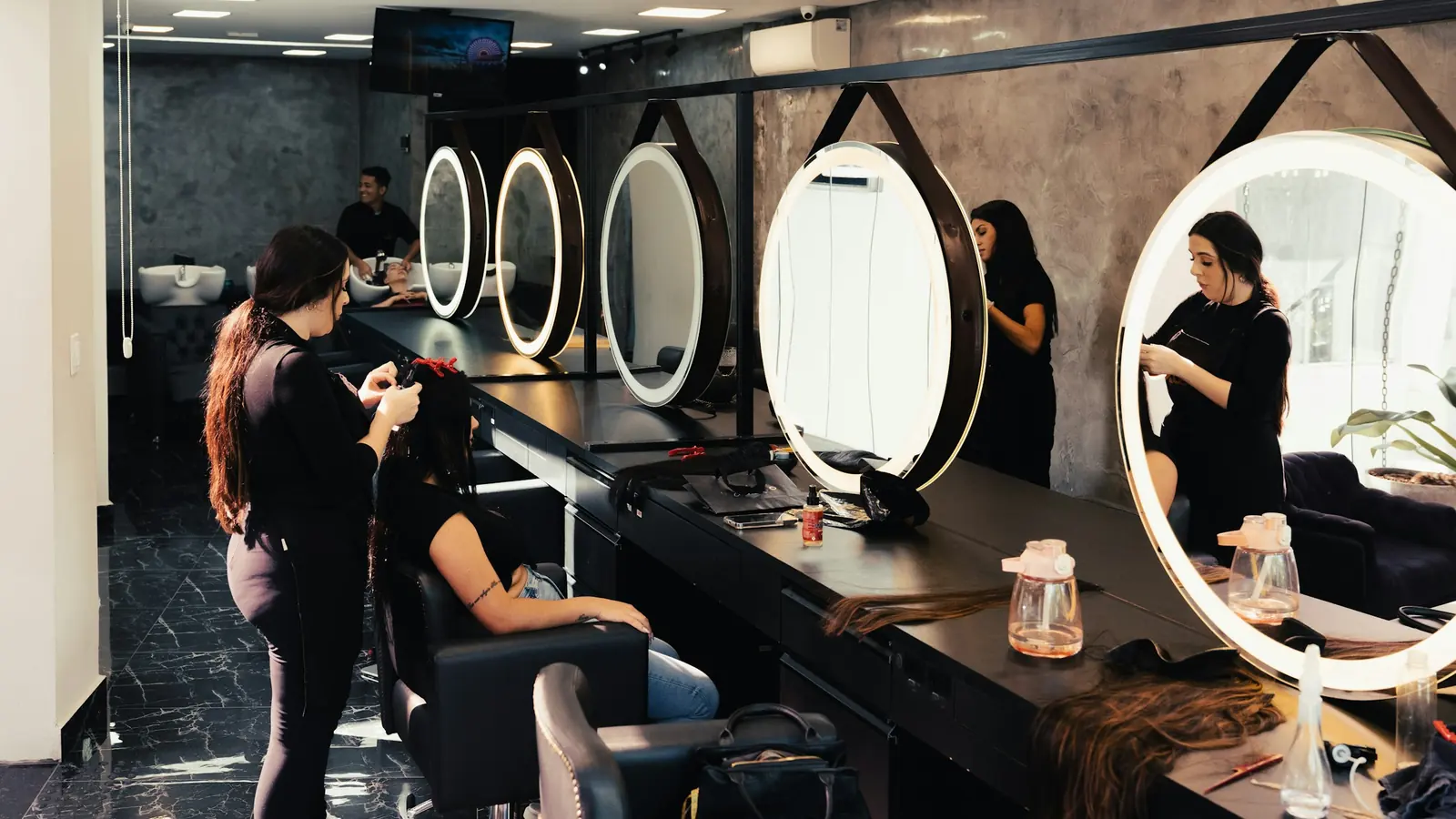
The number Google gives you for stylist pay leaves out roughly half the people doing the job.
The number everyone quotes for hairstylist pay describes barely half the profession. Not because it is wrong, but because of who it counts and who it quietly leaves out.
Here is the real figure, where it comes from, and why the stylist in the chair next to you can be earning double it.
The short answer
According to the U.S. Bureau of Labor Statistics, hairdressers, hairstylists, and cosmetologists earned a median of $35,250 a year, or $16.95 an hour, as of May 2024. The average, which sits higher because top earners pull it up, was $43,460 a year or $20.89 an hour.
Median monthly, that works out to roughly $2,940 a month before tax.
| Where you sit | Per year | Per hour |
|---|---|---|
| Lowest 10 percent | $24,580 | $11.82 |
| Median (half earn more) | $35,250 | $16.95 |
| Top 25 percent | $48,300 | $23.22 |
| Top 10 percent | $70,220 | $33.76 |
Source: U.S. Bureau of Labor Statistics, Occupational Employment and Wage Statistics, May 2024, occupation 39-5012, covering 295,460 employed stylists. Hourly figures at the 10th and 75th percentiles are the annual figures divided by 2,080 hours.
Why that number is lower than what you see in the salon
Read the fine print on how that survey is collected and the picture changes.
It only counts people on a payroll. The Bureau's wage survey covers wage and salary workers. It does not include the self-employed, and by the Bureau's own projections roughly half of hairdressers and cosmetologists work for themselves. Every booth renter, every suite owner, every independent stylist is missing from that median.
So the most-quoted number in the industry describes the employed half and says nothing about the half who rent their chair. That is the single biggest reason the figure feels wrong to anyone who works in a salon.
Tips land unevenly. Cash tips in particular get reported inconsistently, which pushes the recorded number below what actually goes home.
Part-time work counts as a full person. An annual figure covering a stylist working three days a week sits in the same pool as one working six.
None of this makes the median useless. It makes it a floor for one half of the profession rather than a description of the whole job.
What hairstylists make per hour
The median is $16.95 an hour. The top ten percent clear $33.76.
The hourly framing is the least useful one in this trade, though, and it is worth knowing why. Very few stylists are paid by the hour. They are paid a percentage of what they ring up, or they pay rent and keep the rest. An hourly figure is a division problem someone did afterwards, not a wage anyone negotiated.
What actually decides the hourly number is how much of the day is booked. A stylist charging well with a full column earns multiples of one charging the same prices with gaps at two and four.
What hairstylists make per month
At the median, about $2,940 a month before tax. At the top quarter, closer to $4,020. In the top ten percent, around $5,850.
Monthly is where the trade gets uncomfortable, because the number moves. December and prom season are not February. A stylist earning the median across a year can have months well under it and months well over, and the ones who last are the ones who plan for that rather than being surprised by it every winter.
The spread is the story
Look again at the table. The top ten percent earn nearly three times the bottom ten percent, doing what is nominally the same job with the same license.
That gap is not mostly talent. Plenty of brilliant stylists sit near the bottom of it. The gap comes from a handful of things that have nothing to do with how well you can cut.
What you charge. The most direct lever, and the one most stylists leave alone for years while product and rent climb around them.
How full the book is. A price rise on a half-empty column is arithmetic, not income. Rebooking before she leaves the chair is what makes the price stick.
What you are known for. Specialists charge more than generalists in every trade, and hair is no exception. An extensions specialist or a colour corrector prices differently than someone who does a bit of everything.
Where you work. Wages track local prices. The same skill earns differently in a coastal metro than three hours inland.
Whether strangers can find you. A stylist whose work never appears when someone searches locally is competing only for whoever walks in.
Commission, booth rent, and salary pay very differently
Two stylists can ring up identical numbers and take home amounts that are not close, because of how they are paid.
Commission pays a percentage, often somewhere between forty and sixty percent, and the salon carries product, rent, marketing, and the front desk. Lower ceiling, far lower risk, and nothing to run.
Booth rent means a fixed weekly or monthly payment for the chair, and everything above it is yours. Higher ceiling, and you now own the empty weeks, the product cost, the marketing, and the tax bill nobody withheld for you.
Salary or hourly is the rarest of the three, usually with a commission bonus on top.
Booth rent looks like more money until a slow month arrives and the rent is due anyway. The stylists who do best on rent are the ones who moved to it with a full book already, not the ones who moved hoping to build one.
How to actually move up the range
The honest order, fastest first.
Raise prices on the services already in demand. If you are booked out three weeks, the market has told you your prices are low.
Fix rebooking before chasing new clients. Getting a new client is expensive. Keeping one is nearly free, and a stylist rebooking eight in ten builds a full book on new clients that would leave someone else half empty.
Pick a thing to be known for and post that thing. A feed showing every service you offer tells a stranger nothing.
Get your name into the salon's Google presence and into reviews. When a client writes that you did her balayage, that sentence is what makes you findable.
Then, and only then, consider the move to booth rent. The ceiling is real, but it only pays when the book is already full.
If you own the salon
These numbers are your hiring market, and they cut both ways.
The median tells you what a stylist can walk down the street and get. If your best colourist is earning near it while producing well above it, someone else's offer will eventually be interesting to her.
The more useful move is to compete on the things the number cannot show. A stylist who is growing a name, getting featured, and building a book at your salon is being paid in something a competitor cannot match with a dollar more an hour. Marketing your people is a retention tool, and most owners never think of it that way.
The one place to be careful is booth rent. Converting a commission floor to rent moves risk onto stylists who may not be ready to carry it, and the ones who fail on rent leave. Look at whose book is actually full before you restructure anything.
The short version
The median hairstylist earns $35,250 a year. Half the profession is not in that figure at all. The top ten percent earn nearly three times the bottom ten, and the distance between them is mostly pricing, rebooking, and being findable rather than raw skill.
Which is the good news, because all three of those can be changed on purpose.