
Most salon websites lose the booking in the first ten seconds, and it is almost never because they are ugly.
Most salon websites lose the booking in the first ten seconds. It is almost never because they are ugly.
They lose it because a woman on her phone, standing in her kitchen at nine at night, cannot find the one thing she came for. She wanted to see whether you do her hair, roughly what it costs, and whether Thursday is free. If those three answers are more than a couple of taps away, she goes back to the search results and books the next salon.
The only job
A salon website has one job. Turn a stranger who is already interested into an appointment.
That sounds obvious until you look at what most salon sites lead with. A slideshow. A welcome message. A paragraph about passion. Meanwhile the booking button is at the bottom, the price list is a PDF, and the phone number is an image so it cannot be tapped.
Every element on the page either moves her toward booking or gets in the way. There is no neutral.
The five things a salon website needs
1. Booking, above the fold, on every page. Not "contact us." Book. If you use a booking system, link straight into it. If you take appointments by phone, make the number a tap-to-call link. She should never have to hunt.
2. It has to be fast on a phone. Most salon traffic is mobile, often on a middling connection. A site loaded with huge unoptimised photos and five tracking scripts takes long enough that people leave before it appears. Speed is not a technical nicety here, it is the difference between a booking and a bounce.
3. Prices, or at least starting prices. The single most common objection to this is that competitors will see them. Competitors already know. Hiding prices does not protect you, it filters out the client who wanted to know what she was walking into, and she was the one ready to book.
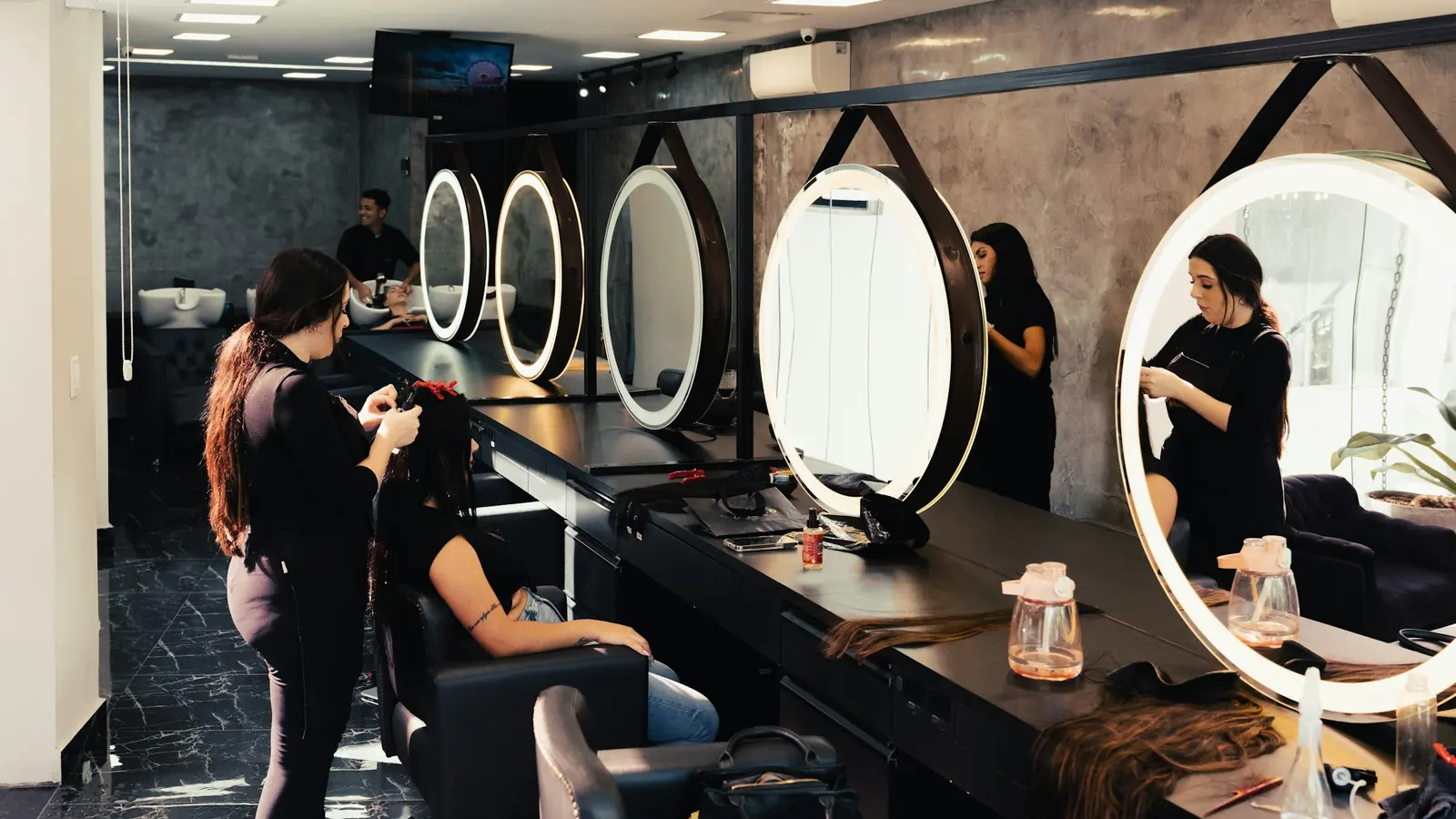
4. Real photographs of real work. Not stock. A stranger is deciding whether to trust you with her hair. Your own before and afters, your own space, your own team. Stock photography of a woman laughing at a salad tells her nothing and she can spot it instantly.
5. Location, hours, and parking, in text. Written as text, not baked into an image, because that is what Google reads and what a phone can act on. Parking sounds trivial. In a busy neighbourhood it decides bookings.
What to leave off
The autoplaying video header that delays everything behind it.
The pop-up asking for her email before she knows what you do.
The mission statement above the services.
A separate page per stylist that nobody links to. One team page with real photos does the job.
Any menu with more than six items in it. Every extra choice is a chance to wander off.
Website builder, or hire someone
Both are legitimate. They fail in different ways.
A builder gets you live cheaply and quickly, and modern templates look fine. The catch is that the defaults are built for every business on earth, so the booking link ends up buried in a nav bar, the images ship at full size and the site crawls on a phone, and the search settings sit untouched. A builder site works when someone deliberately fixes those three things. Left on defaults, it is a brochure.
Hiring a designer buys judgment, and the risk is the opposite one. You can pay well for something beautiful that was never built to book or to be found. The tell is whether they ask about your booking system and your local search before they show you a single layout. If the first conversation is about colours, the site will be about colours.
The honest rule: if you are opening and cash is tight, use a builder and spend your effort on the booking link, the image sizes, and your Google profile. Once the chairs are paying, a properly built site is worth more than the difference.
Do you even need one?
A fair question when you already have Instagram and a booking app.
You can run a small salon or a suite on those two alone, and plenty do. What you give up is search. A woman who searches for a stylist in your town does not scroll Instagram to decide. She reads Google, and Google shows profiles and websites. Without a site you are relying entirely on your Google Business profile, which works right up until a competitor with both outranks you.
So: suite or solo stylist with a full book, you can wait. A salon with staff to keep busy, you need one.
The search minimum
A site that nobody finds is a business card you cannot hand out. Five things do most of the work.
A page per main service, so the salon can rank for the things it actually does rather than only for its own name.
Your town in the page titles, written the way people say it.
Text Google can read, which means not putting your services and prices inside images.
Your name, address, and phone identical to the Google profile, down to the punctuation.
A site that loads fast on a phone, which is the same requirement as before because it matters twice.
What to ask before you pay anyone
Which booking system will this connect to, and how many taps from the homepage.
What will it score on a phone speed test when it is finished.
Will I have a page for each service, and who writes them.
Do I own the domain, the hosting, and the content if I leave.
Can I edit my own prices and hours without calling you.
That last one catches more people than the rest combined. A site you cannot update goes stale in a season, and stale hours cost real bookings.
The test
Open your own site on your phone, on data rather than the salon wifi. Time how long until you can see something. Then count the taps to a booked appointment.
If it takes more than about three seconds to appear, or more than two taps to book, that is your entire website problem, and it is fixable without a redesign.
Prefer it handled for you? See salon websites built to book and to rank.